Politics

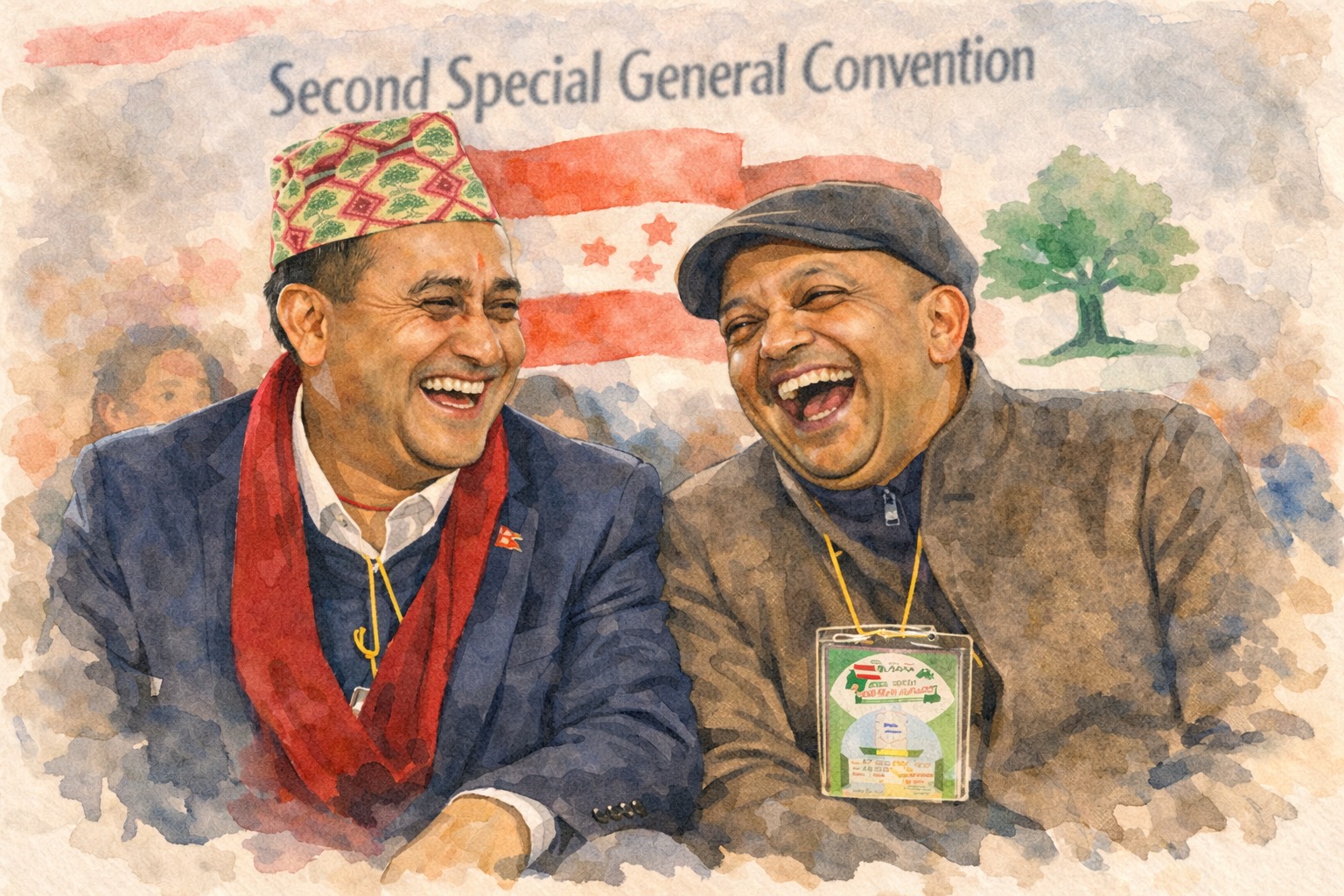
Nepali Congress's extended Special General Convention (SGC) concluded Wednesday midnight, electing an inclusive 166-member Central Working Committee led by the party's two prominent and relatively youthful leaders: Gagan Thapa as President and Bishwa Prakash Sharma as Vice-President. The SGC and the circumstances leading to their unanimous election will reverberate down the decades and will have both immediate and long-term repercussions revolving around two key narratives.
According to one narrative, the long-running generational tension amidst growing demand for transfer of leadership – meaning, power in de facto terms – has finally ended in the Nepali Congress.
According to another, the generational tension has only just begun.
If you are a Congress party member, a supporter, or a well-wisher, which narrative you subscribe to depends on which side of the fence you stand in Nepal's, particularly in Nepali Congress's binary world of politics.
Both narratives may have their own merits or demerits. According to the country's leading legal luminaries, the SGC process led by Thapa and Sharma appears to have a clear edge over the establishment side, which comprises Congress President Sher Bahadur Deuba, Vice-President Purna Bahadur Khadka, and, now, Shekhar Koirala. Shekhar was a formidable challenge to Deuba and, probably the most powerful in the protracted tripartite tussle for party leadership until recently, but appears to have lost substantial ground post-SGC. The Deuba side has several other seasoned Congress leaders in the frontline, including Krishna Prasad Sitaula, Bimalendra Nidhi, Prakash Man Singh, and Dr Sashanka Koirala (the latter has maintained a delicate balance in handling the latest imbroglio involving Deuba-Khadka-Koirala vs. Thapa-Sharma). Both sides have approached the Election Commission claiming "legitimacy"-meaning the party flag and the legendary election symbol: the Tree.
The Deuba side suspended Thapa, Sharma, and Vice-General Secretary Pharmula Mansoor for a period of five years on the fourth day of the SGC (Wednesday, January 14), just several hours before the SGC concluded, electing the new Central Working Committee. The Special General Convention led by Thapa and Sharma on its second day (January 12) dissolved all elected bodies of the Congress party, receiving thunderous applause from, according to the organising committee, 2,488 delegates assembled in Kathmandu. Both sides have approached the Election Commission with claims and counterclaims, and actions and counteractions will be coming under the scrutiny of, first, the Commission and then the Supreme Court, which will clearly impact the electoral calendar, now running at full speed. On Tuesday (January 20), as per the election calendar, all party candidates will have to file their nomination papers under the first-past-the-post system for the general elections due on March 5.
The semi-judicial Commission will take its call at the earliest, but that 'verdict' is sure to be challenged in the Supreme Court. If one side does not, the other will. For now, the Congress party has two presidents and two parallel central working committees with Deuba and Thapa at the head of their respective sides.